My Ahnentafel
Definition | 14-gen | GEDCOM


|
||
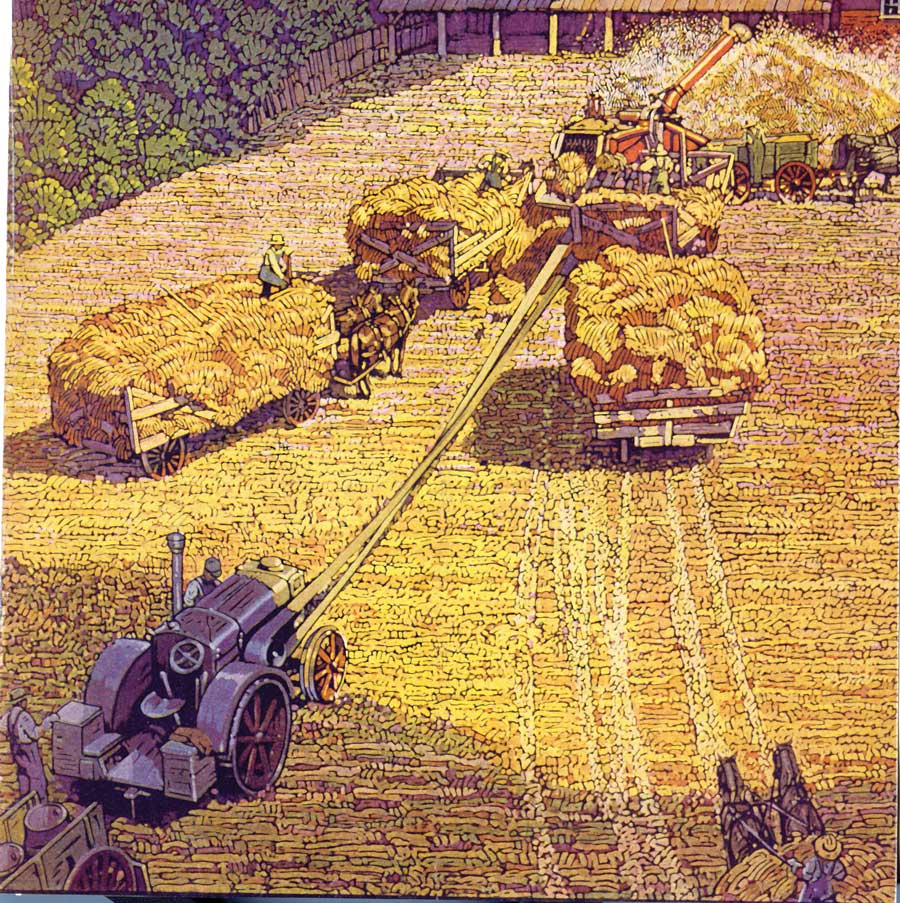
The cover of the July 1933 issue of
Successful Farming Magazine. The author of the following story about Will McDowell's threshing crew (c1910) is unknown. A xerox copy of the typewritten original was provided to me by my grandmother about twenty years ago. I do know it was published in the September 1990 issue of a periodical by the Iowa Historical Society. If anyone has further information, please contact me. I lifted the image from farmcollector.com. Threshing With Steam As I Remember ItIt all began about the first week of July when you heard your father tell your mother that he supposed he had better get the threshing coal. He then hitched the team to the old wagon - the one with the loose tires and the leaky box - and went to the Elevator or the Lumber Yard in Tingley (depending on which one had a car of coal on track). If you were hardup you bought Centerville coal and if you had money and wanted to make the operator of the threshing outfit happy, you purchased Illinois coal for it burned better and with fewer clinkers. We usually bought Centerville coal. When my father arrived home he hauled the load of coal near where he planned to thresh and left it. We would continue "laying by" our corn and in the meanwhile watching as our field of Timothy seed ripen. Usually before the Timothy was ready to be threshed some of our neighbors would decide to thresh their oats. This was often someone who had no Timothy to bind so while helping our neighbors thresh we must finish cultivating the corn and also bind and shock our Timothy. Somehow we would struggle through this crisis and the threshing season was under way. We threshed with several different outfits through the years from 1910-1920 but I am going to write of only one. The owner of this particular outfit was a slender wiry dark complected man who ran the engine. The separator man was our neighbor Poe Johnston. They made a good team. The owner of the machine could get mad when things went wrong but Poe was always good-natured and never became excited. Both had large families. The engineer's family was mostly girls, with two boys. Poe's family consisted of six boys and one girl. The third member of the threshing crew was the water hauler sometimes referred to as the water monkey. In this case the water monkey was the engineer's son, Clyde. The threshing run went like this...oats were threshed first until the Timothy was ready and when the farmers had both oats and Timothy which were ready they would be threshed before the machine left that particular farm. After the farms with oats and Timothy were threshed then the machine went back and threshed the Timothy which had been by-passed. When the big day arrived and the outfit pulled onto our farm my father indicated where the machine was to be set. Poe Johnston, the separator man, tossed some chaff in the air and watched it drift away. This helped him decide what direction the wind was coming from and where to set the machine in order that the dust and dirt would be blown away from those working around the machine. The engineer then made a circle with the outfit that would leave the separator in the right position. When the machine was properly located the separator man would start digging holes for the wheels to drop into so that the machine would set level. The test of a good separator man was his ability to dig these holes accurately that the machine would be level without a second try. Any operator of the separator worth his salt would claim perfection in this, but I well remember seeing Poe Johnston digging superstitiously under one wheel when the chaffers failed to clear properly. With the separator properly set the engine was uncoupled and the engineer with the assistance of the water monkey made a half circle that turned the engine around and lined it up with the belt pulley of the separator. Now here was the test of the engineer. A good engineer never had to make a second attempt at lining up. Of course, both pulleys were crowned and the belts would run OK even if the pulleys were out of line a few inches, but at 10 years old you didn't really know that. In the meantime the separator man had raised the blower up and turned it around, unfolded the feeder and was unreeling the drive belt. When the belt was unreeled, the engineer got on the engine drive wheel and together they got the heavy belt onto the giant drive pulley. The next step was to tighten the drive belt. With the separator man holding the flopping giant belt the engineer placed the engine gently in reverse - the belt flapped and flopped like a living thing as it tightened. The water monkey threw wooden blocks in front of the drive wheels of the engine and they were ready to start threshing. Grain haulers would start backing tight wagon boxes up to the grain spot, loads of bundle wagons would be maneuvering up to the feeder and the water monkey would haul the water wagon up on the left side of the engine then hitch his team to the load of coal and pull it up to the rear of the engine on the right side. The separator man would be busy turning down grease cups (the old time version of grease guns) and oiling and adjusting the machine. Soon he would stand up and nod to the engineer who would then open the throttle and the wheels would begin to turn - slowly perhaps for 30 seconds while the separator man checked to see that everything was working properly. Then the engineer would open up the throttle to normal operating speed and we were threshing. There was something fascinating about the steam engine. The combined odor of coal, water, steam, heat and oil produced a fragrance that was hard to forget. The engine seemed to be alive and breathing. The cacheting of the oiler, the governor with its tiny belt and the push and pull of the cylinder made a beautiful picture in the memory. Its power was quiet and uniform. The threshing separators of that day were huge machines. They seemed almost unlimited in capacity and were noisy and dirty. You were suppose to feed the bundles in the machine head first but the feeder was so big no one paid much attention unless the dividing board was in. Water hauling could be hard and difficult work. The tank which held about 120 barrels of water was placed on a heavy truck set of running gears and on top of the tank was a double action pump with about 20 feet of suction hose. This hose was placed in a well and the tank pumped full of water. The pump was operated with a long wooden handle and it worked hard. Moat water monkeys spend considerable time trying to "con" someone into going once. Sometimes he had to go several miles after water and he was under time pressure for the engine must not be allowed to run low. It was customary to make fun of the water monkey because he could take a nap and leaf a little after he had brought the engine its vital water supply, but in truth, he was one the hardest working members of the crew. The engine whistle was an important part of the outfit. Each outfit had a set of signals. One signal might say, "wake up separator man. Something is going wrong." Another signal would say, "Hurry up grain haulers." While still another one would say, "Hurry up bundle haulers" and then there was the blast that told the water money that he must get water to the engine as soon as possible. Some farmers stacked the straw, some didn't. In 1910 nearly everyone did. Before 1910 thresher separators were equipped with traveling carriers which gently lifted the straw onto the stack. In that day the work was hard and a little dirty. After 1910 the blower came into vogue and straw stacking became a very hard disagreeable and dirty job. Timothy and oat straw was an important part of the diet of the beef cow herd of that day and the farmer wanted it preserved in the best possible way, but many farmers were unable or unwilling to pay the price in sweat, breathing dust and dirt, so more and more the straw was blown into a pile. The threshermen's dinner was something else. My mother usually worked with her sister and my grandmother or some neighbor lady. It required many hours of hard work and planning. The crew might include as many as 30 people and it required 2 or more tables before all were served. There was friendly competition among the women of the community to see who could serve the best meal. The food could be, and usually was, out of this world both in quality and quantity. Washing for dinner involved washing in cold water out in the yard and drying face and hands on a towel that soon revealed that those having washed before had not done a very good job of it. The men having washed before had not done a very good job of it. The men also combed their hair before an old mirror hanging from a tree. The men operating the machine always ate at the first table and there was a lot of fun while eating but if you were a ten year old boy you did not get to share in it because you had to wait and eat at the third table with the women. You always wondered if there would be any food left for you. Under the influence of so much good food the crew was often slow getting back to work. In that case the engineer would give the engine whistle a couple of toots as is [if] to say, "Get on the ball, we're ready to start." One year the fun finished at our farm - we were threshing Timothy. It was after September 1st and I had started to school. It was nearly dark when the bundle haulers cleaned up around the machine and went home. Our wagons were piled high with white sacks of Timothy seed. Poe Johnston said to me, "Sonny, run to the house and see if your mother will let me have her broom." Flushed with importance I raced to the house, got the broom and was back in a jiffy. The machine was stopped. Poe carefully swept every bit of chaff and dirt off the machine They then started up the separator again and blew out all the dirt that had fallen out of the cylinder - this done, they stopped, folded up the blower and feeder and coupled the engine onto the separator and pulled it away from the stack. The engineer then looked at Poe - they were happy that the run was over. Poe grinned and nodded at the engineer who then reached for the leather throng that operated the whistle. I knew what was coming - this was to be the finishing whistle - a long, long, long blast that told the world that the run was over. I was determined not to be a sissy and hold my had over my ears as girls nearly always did. The engineer pulled the whistle valve open. A wail like 1000 banshees broke over our valley. On and on it went, my ears began to throb and then to ache. I decided it wasn't such a bad idea to be a sissy after all and covered my ears with my hands. Still this mighty whistle roared on and the sound must have gone west across Walnut Creek Valley past Wishard Chapel to Crooked Creek and beyond. To the east it echoed and re-echoed across Gooseberry Creek and East Grand River Valley over to and beyond High Point Church. Yes, and the men and women of the day who now sleep in our beautiful
cemeteries listened and looked at each other and said, "It sounds like Billy
McDowell has finished his run!"
All original portions © 1994-2026 Michael Cooley, OrbitInternet.net - Copyright Notice /HTTP Validation |
